The survey behind the data
The ROS Database is the living companion to a comprehensive survey of the Robot Operating System ecosystem, published in ACM Computing Surveys.
ROS 2 in a Nutshell: A Survey
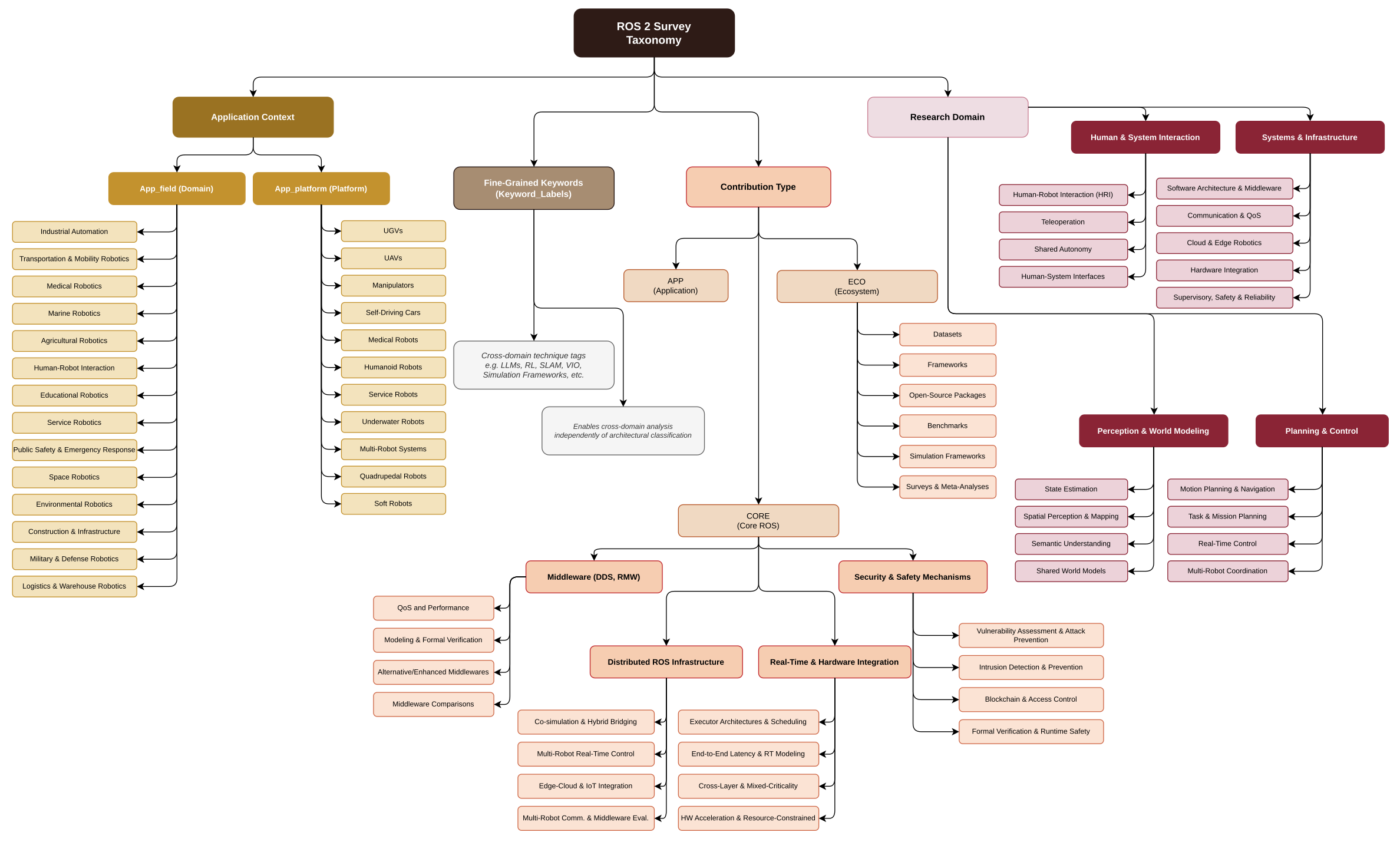
A comprehensive survey of the Robot Operating System and its successor ROS 2 — covering the middleware architecture, the research landscape, and the community ecosystem. The paper introduces the multi-dimensional taxonomy that organizes this database: contribution type (application / core / ecosystem), research domain and subdomain, application field and platform, and 139 fine-grained topic labels.
Read the paper — doi:10.1145/3815113
Dataset
Contribute
The dataset lives on GitHub and is maintained in the open. Add a missing paper, fix a classification, or list your package.
How the dataset was built
A systematic pipeline — from publisher databases to the living website — keeps the index comprehensive, deduplicated, and consistently classified.
Database search
Publications harvested across IEEE Xplore, ACM DL, Springer, Elsevier, SAGE, Google Scholar and more, compiled into one master list.
Metadata extraction
Title, authors, abstract, venue, publisher, DOI and BibTeX gathered for every candidate paper.
Relevance filtering
Each paper screened for genuine ROS / ROS 2 content; duplicates and false positives removed.
Labeling
Classification along independent axes: contribution type, research domain & subdomain, application field & platform, and 139 topic labels.
Living database
Published as an open dataset with CI validation, a weekly OpenAlex scrape, and this auto-updating website.
The full survey taxonomy
The complete classification framework from the paper — contribution type, research domains and subdomains, application context, and fine-grained keyword labels. Explore it interactively or click to enlarge.
Authors






What is ROS?
The Robot Operating System is the de-facto standard middleware for building robot software — a graph of loosely coupled nodes exchanging messages over topics, services, and actions. ROS 2 rebuilt that foundation on DDS for real-time, multi-robot, and safety-critical production systems.
This site tracks how that ecosystem evolves through its research output: 8,500+ papers, 176 packages, and seventeen years of trends.